

Name
The root of Dr. V’s last name is Alator, where the suffix denotes familial relations and conveys gender information. This page is included not merely for etymological interest, but because the name itself functions on the website as part of the company’s identity, symbolism, and intellectual narrative.
Alator is a Celtic deity known exclusively from Romano-British contexts, where he is equated with Mars, the Roman god of war. In medieval Welsh literature, the name echoes in Aladur, a poetic reference linking to King Arthur as a descendant, suggesting that Arthur is metaphorically or mythologically from the lineage of Mars Alator, thereby implying a divine or heroic ancestry that elevates him beyond a mere mortal king. This association gives the name a mythological dimension connected to strength, lineage, and symbolic elevation.
Celtic linguists interpret Alator’s name as a deity associated with “father/god of the people” or “he who rears or nourishes the people.” The name Alator was invoked in an inscription on a silver-gilt votive plaque found in 1743 at Barkway, Hertfordshire, England, bearing a dedication to Mars, the Roman god of war.
The plaque, made of silver-gilt, measures approximately 10.2 cm wide by 18.1 cm high. It has a flat top decorated with a leaf pattern. Embossed in the center is a shrine formed by two twisted columns with leaf-capitals, surmounted by a pediment enclosing a wreath. Within the shrine stands a frontal figure of Mars, the Roman god of war, with his head turned to the left. He is depicted in full panoply (armor), holding a spear in his right hand and resting his left hand on a shield. Below the shrine is an inscription in an ansate (handled) panel. The level of detail in this object is part of what gives the name an unusually concrete historical presence rather than a merely abstract legendary one.
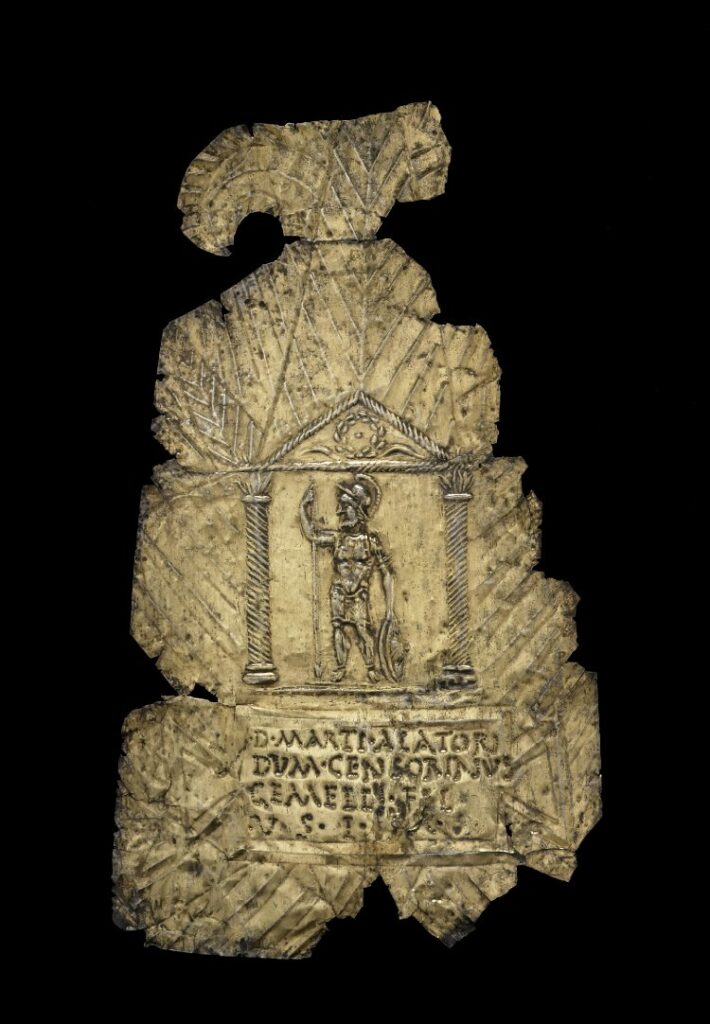
The inscription reads: “D(eo) Marti Alatori Dum(…) Censorinus Gemelli fil(ius) v(otum) s(olvit) l(ibens) m(erito),” which translates to “To the god Mars Alator Dum(…), Censorinus, son of Gemellus, willingly and deservedly fulfilled his vow.” The “Dum(…)” is an abbreviation that may refer to a local epithet of Mars Alator or possibly “Dumnonius” or “Dumerius” as a nomen (family name), though no clear parallels exist.
In 1817, the plaque was acquired by the British Museum and became part of its collection.
The name Alator was inscribed on an altar discovered in 1887 west of the Roman fort at South Shields, Durham, England, equating Alator to Mars, the Roman god of war. The altar dedicated to Mars Alator, made of buff sandstone, measures 30.5 cm wide by 76.2 cm high. The left side features carvings of a patera and jug (ritual items), while the right side is broken. The inscription reads: “Mar(ti) Ala(tori) G(aius) Vinicius Celsus pro se et […] v(otum) s(olvit) l(ibens) m(erito),” translating to “To Mars Alator, Gaius Vinicius Celsus for himself and … willingly and deservedly fulfilled his vow.” It was originally in the Black Gate Museum, and later transferred to the Museum of Antiquities in Newcastle upon Tyne, and is now (as of 2009) housed in the Great North Museum: Hancock. Together with the Barkway plaque, this second inscription reinforces the historical footprint of the name and its association with martial and divine imagery.
Interestingly, in Slavic mythology, Alatyr, a variation of the name Alator, is a white and fiery stone with healing and magical powers that fell from the sky and was used by the god Svarog to create planet Earth, oceans, and life. In Sanskrit, the name of the god Svarog is said to mean “he who walks across the sky,” and he is also known as “Heavenly Father” or simply “God.” Svarog was the main Slavic god before Christianity was introduced into Slavic culture from the 860s to the 990s CE. Legend holds that the sacred stone Alatyr, also known as the center of the universe, is represented by Mount Elbrus (White Mountain), the highest dormant volcano in Europe and Western Asia, located in the Caucasus region of Russia. It is said that a Church of God with the Alatyr altar once stood on a slope of the sacred Mount Elbrus, suggesting a link between Alatyr and the church altar used for sacrifices in the name of God. This Slavic parallel broadens the symbolic field of the name beyond the Celtic-Roman world and introduces associations with creation, sacred centrality, and cosmic origin.
References:
- Mars Mythology (Wikipedia) at http://en.wikipedia.org/wiki/Mars_(mythology)
- British Museum Barkway Votive Plaques (Wikipedia) at http://en.wikipedia.org/wiki/File:British_Museum_Barkway_Votive_Plaques.jpg
- Christianization of Slavs (Wikipedia) at http://en.wikipedia.org/wiki/Christianization_of_Kievan_Rus’
- Mount Elbrus (Wikipedia) at http://en.wikipedia.org/wiki/Mount_Elbrus
- Alatyr Mythology (Wikipedia) at https://en.wikipedia.org/wiki/Alatyr_(mythology)
- Alator Ancient History at https://www.thoughtco.com/celtic-gods-and-goddesses-117625
- Roman Inscriptions of Britain (RIB) Volumes: Primary source for the inscriptions, with detailed analysis in RIB 218 (Barkway) and RIB 1055 (South Shields).
- These are part of a comprehensive catalog of over 2,400 Romano-British inscriptions: Describes the plaque in “Religion in Roman Britain” by Martin Henig (2005) and museum guides, noting its role in illustrating syncretic worship.
- “An Assessment of the Evidence for the Cult of Mars in Roman Britain” (2014): Discusses Mars syncretisms, including Alator as not purely martial.
- “Pagan Celtic Britain” by Anne Ross (1996): Explores etymologies and fertility aspects.
- “The Ancient Celtic Pantheon” (World History Encyclopedia, 2021): Lists Alator as a warrior/protector equated with Mars.
- “Patterns of Worship in Roman Britain: Double-Named Deities” (undated): Notes Alator’s southern and northern distribution.
- “Aspects of the Archaeology of the Brigantes” by K.J. Fairless (1989): Analyzes the Brigantian context of the South Shields inscription.
- Entries in “Gods and Goddesses” (online encyclopedia) and “NovaRoma” wiki detail Alator’s possible hunter or cherisher roles.
- Thomas Green, “A Note on Aladur, Alator and Arthur,” Studia Celtica 41 (2007): 237–41. This short paper (originally drafted around 2001-2005) provides the core etymological and textual analysis, citing supporting evidence from place-names (e.g., Coedladur and Nant Ladur in Wales) and Romano-British epigraphy.
- Thomas Green, Concepts of Arthur (Stroud: Tempus, 2007), especially pp. 180–194, 229–230, 237, 247, 255–261. Here, Green expands on Arthur’s potential divine origins, positioning the “Aladur” reference within a framework of Celtic mythology and suggesting Arthur as a pan-Brittonic manifestation of a protective war-god like Vellaunos-Esus.
- D. Ellis Evans, “Aladur,” Bulletin of the Board of Celtic Studies 16 (1955–56): 274 (on “Aladur” as a Welsh personal name).
- R.G. Collingwood and R.P. Wright, The Roman Inscriptions of Britain, vol. 1 (Oxford: Clarendon Press, 1965), nos. 218 and 1055 (primary sources for Mars Alator inscriptions).
- Garrett S. Olmsted, The Gods of the Celts and the Indo-Europeans (Budapest: Archaeolingua, 1994), pp. 96, 109–11, 116–19, 152–3 (on Alator as a Celtic divinity).
- Patrick Sims-Williams, “The Early Welsh Arthurian Poems,” in The Arthur of the Welsh: The Arthurian Legend in Medieval Welsh Literature, ed. Rachel Bromwich et al. (Cardiff: University of Wales Press, 1991), pp. 33–71 (contextual analysis of Kadeir Teyrnon).
- Marged Haycock, “Some Talk of Alexander and Some of Hercules: Three Early Welsh Poems Exhibiting Typological Features,” in The Medieval Mind, ed. Cynthia Neville (Toronto: University of Toronto Press, forthcoming at the time; discusses poem’s obscurity).
- Secondary discussions appear in online Arthurian studies and blogs, often summarizing Green’s work: Arthuriana.co.uk (concepts section). Blogs like “Shadows in the Mist” (April 2019 posts) and “Coeling Chronicler” (2025 articles), which speculate on Alator’s northern British ties (e.g., South Shields fort) and Arthur’s “descent.”
- Relevant Web Pages: Arthur in Medieval Welsh Literature (University of Wales Press … 128 pages. Language: English. Publisher: University of Wales Press. Publication date: August 15, 2013. Dimensions: 5.5 x 0.5 x 8.5 inches. amazon.com
- [PDF] A Note on Aladur, Alator and Arthur – Arthuriana [The following version of this paper is made available via www.arthuriana.co.uk ; the final published version is T. Green, ‘A Note on Aladur , Alator and Arthur ’, Studia Celtica , 41 (2007), 237–41] A Note on Aladur , Alator and Arthur The following lines open the Book of Taliesin poem Kadeir Teyrnon : areith awdyl eglur awen tra messur am gwr dewr awdur o echen aladur A brief and clear poetic composition, poetic inspiration beyond measure, concerning a valiant warrior, a protector, from the tribe/family/lineage of Aladur. 1 The poem as a whole is obscure and garbled. Haycock has translated portions of it in her study of Taliesin’s questions 2 but there is no satisfactory published treatment of the whole. The first part of the poem continues the description of the hero depicted in lines 3-4 down to line 14, at which point it breaks off and appears to name three men: Teyrnon, Arthur, and (perhaps) Heilyn. This note is primarily concerned with this initial portion of the text – most especially the fourth line. arthuriana.co.uk
- Arthur in Medieval Welsh Literature | UWP – University of Wales Press A fascinating survey of the numerous references to Arthur found in medieval Welsh literature emphasising the diverse literary genres used. uwp.co.uk
- Arthur in Medieval Welsh Literature by O.J. Padel – Goodreads Arthur in Medieval Welsh Literature is an important and revealing contribution to Arthurian studies and will appeal to anyone interested in … goodreads.com
- Arthur in Early Welsh Poetry (Mhra Library of … – Harvard Book Store harvard.com
- Arthur in Medieval Welsh Literature – TEP Books By the twelfth century Arthur was a renowned figure wherever Welsh and its sister languages were spoken. O.J. Padel proves an overall survey of medieval Welsh … tepbooks.com
- The Arthur of the Welsh: The Arthurian Legend in Medieval Welsh … This volume is unique in offering a comprehensive discussion of the subject. It will appeal widely to medievalists, to W… dokumen.pub
- (PDF) A Note on Aladur, Alator and Arthur – Academia.edu It is suggested that Arthur is the subject of the first part of this poem, and that the description of this subject as o echen aladur should be read as a … academia.edu
- Arthur in Medieval Welsh Literature – Google Books By the twelfth century, Arthur was a renowned figure wherever Welsh and her sister languages were spoken. O. J. Padel now provides an overall … books.google.com
- Arthur in Early Welsh Poetry (Mhra Library of Medieval Welsh … For over a thousand years, Arthur has had widespread appeal and influence like no other literary character or historical figure. Yet, despite the efforts of … amazon.com
- The Arthur of the Welsh: The Arthurian Legend in Mediev… Her focus was on medieval Welsh literature, and she taught Celtic Languages and Literature in the Department of Anglo-Saxon, Norse and Celtic at … goodreads.com
- [PDF] A Bibliographic Guide to Welsh Arthurian Literature Thomas Green Most of the early references to Arthur are found in only a handful of manuscripts, briefly outlined below. In addition to the references cited in the individual … arthuriana.co.uk
- (PDF) The Arthur of the Welsh: The Arthurian Legend in Medieval … The Arthur of the Welsh is intended to supplement and revise the early chapters of the landmark Arthurian Literature in the Middle Ages. academia.edu
- Why are so many famous Arthurian knights, a Welsh story, non-Welsh? This area became known in medieval Wales as “Yr Hen Ogledd,” “The Old North,” and was particularly associated with heroic legends. Cumbric is … reddit.com
- The Arthur of the Welsh | UWP – University of Wales Press This volume gives an account of the Arthurian literature produced in Wales, in both Welsh and Latin, during the Middle Ages. uwp.co.uk
- What can be considered the oldest text about King Arthur Pendragon? For medieval sources, I’m a fan of the three Welsh Arthurian romances, Owain, Gereint, and Peredur. These are short prose adaptations of works … reddit.com
- Medieval Welsh Literature – Andrew Breeze – Google Books In this book, the first general history of the literature of medieval Wales, Andrew Breeze surveys the development of this subject over the course of a … books.google.com
- [PDF] Fulton, H. (2022). The Invention of Arthurian Britain: Arthur in the Arthur in Medieval Welsh Literature. Cardiff: University of Wales Press. ——— 2006. ‘Geoffrey of Monmouth and the Development of the Merlin Legend’,. Cambrian … research-information.bris.ac.uk
- Who was King Arthur? – National Museum Wales King Arthur has evolved into a legend. Tales and romances celebrated the king and his court in the imaginative literature of Europe. museum.wales
- The Arthur of Medieval Latin Literature – jstor In this excerpt from the Welsh-LatinVita Cadoci, King Arthur, seated on a hill and playing dice with Cei and Bedwyr, reacts to a drama taking place below him. jstor.org
- A note on Aladur, Alator and Arthur – ORA It is suggested that Arthur is the subject of the first part of this poem, and that the description of this subject as o echen aladur should be read as a … ora.ox.ac.uk
- Deep Antiquity Within Later Arthuriana – Coeling Chronicler The reference in Kadeir Teyrnon speaks of a great noble chieftain, who is “o echen Aladur.” This means “from the stock of Alator” or simpler … arthwys.com
- Concepts of Arthur It was also suggested that the description of this subject as o echen aladur should be read as a indicating that he (Arthur) was ‘from the stock/lineage/family/ … arthuriana.co.uk
- The Northern Arthur – Coeling Chronicler … o echen Aladur.” This means “from the stock of Alador” or simpler, “descended from Alador” a few have taken this as a reference to the early Romano-British … arthwys.com
- Shadows in the Mist: The Quest for a Historical King Arthur: April 2019 … (o echen Aladur), may be Arthur (who is mentioned in one section of the poem). The identity of Aladur is a mystery, though he may be … mistshadows.blogspot.com
- Arthur and the God Alator of South Shields … (o echen Aladur), may be Arthur (who is mentioned in one section of the poem). The identity of Aladur is a mystery, though he may be … mistshadows.blogspot.com
- Arthur’s Pedigree – Christopher Gwinn … (o echen Aladur), may be Arthur (who is mentioned in one section of the poem). The identity of Aladur is a mystery, though he may be … christophergwinn.com
- Concepts of Arthur 0752444611, 9780752444611 – DOKUMEN.PUB Concepts of Arthur 0752444611, 9780752444611 [](https://www.facebook.com/sharer.php?u=https://dokumen.pub/concepts-of-arthur-0752444611-9780752444611.html) [](https://twitter.com/intent/tweet?url=https://dokumen.pub/concepts-of-arthur-0752444611-9780752444611.html) Table of contents : Contents 1. The Arthur of history: the evidence and its critics 2. The earliest stratum of the Arthurian legend 3. The nature of Arthur: ‘a mighty defender’? 4. The nature of Arthur’s war-band and family 5. The origins of ‘Arthur’ 6. The historicization of Arthur 7. ‘The Arthur of the British’: a maximum view Notes Bibliography ##### Citation preview concepts of arthur Concepts of Arthur THOMAS GREEN For Frances, Evie, John, Jeannette and Vikki First published 2007 Tempus Publishing Cirencester Road, Chalford Stroud, Gloucestershire, gl6 8pe www.tempus-publishing.com Tempus Publishing is an imprint of NPI Media Group © Thomas Green, 2007 The right of Thoma dokumen.pub

Why Work With Alator Consulting
- Analytical, evidence-based approach
- Multidisciplinary expertise
- Experience across business, technology, and science
- Focus on measurable, long-term results
Placed after the historical and mythological material, these practical reasons for working with the firm suggest that the name ALATOR is not used here as a decorative label, but as part of a broader identity that combines symbolic weight with analytical purpose.
Engagement Approach
We work closely with clients to understand their objectives, assess challenges, and develop tailored solutions. Each engagement is structured to deliver clarity, efficiency, and sustainable outcomes. For visitors, this means that the symbolic and historical dimension of the name is ultimately connected to a professional mission centered on serious work, disciplined analysis, and long-term value.
Contact
For inquiries or collaboration opportunities, please contact Alator Consulting to discuss your specific needs.