

Life in Life Theory of Levels (LLTL)
| Life in Life Theory of Levels (LLTL) |
The Life in Life Theory of Levels (LLTL), developed by Dr. Alatortsev, is a scientific and philosophical framework that proposes that life exists not only in the familiar biological forms that we can easily observe, but also as a hierarchy of interconnected levels. In this view, what appears to be a complete system to us at one scale may function as a component of a much larger living system at another scale. At the same time, every such system may itself contain smaller levels with their own internal organization and dynamics. The theory therefore invites the reader to think about life not as a fixed category, but as a nested and relational phenomenon.
The central idea of LLTL is that life should not be understood as something isolated at a single level, such as cells, organisms, or ecosystems. Rather, life should be understood as life within life—a nested structure in which one level exists inside another, while also participating in a larger system beyond itself. This way of thinking invites a broader interpretation of the origin, continuity, and organization of life. This is one reason LLTL is presented not merely as a scientific proposal, but as a broader framework for reconsidering how living systems are organized across scale.
| Core Analogy of LLTL |
To make the theory more understandable, LLTL uses a comparison between the structure of an atom and the structure of a solar system. In a simplified picture of the atom, electrons move around a nucleus. In a solar system, planets move around a star. LLTL proposes that such structural similarities may be more than visual coincidence. According to the theory, systems that appear very different in size may represent different levels of life organized according to related principles. The purpose of this analogy is not to claim literal identity between unlike systems, but to encourage structured thinking about recurrence, proportion, and organization.
Within this comparison, the Earth can be understood as analogous to an electron, but on the next level of life. In other words, the Earth is not merely a planet in physical motion around the Sun. In the LLTL framework, it can also be interpreted as a component of a larger living system, just as an electron is a component of an atomic system on another level. This comparison is intended to help an average reader see the theory not as an abstraction, but as a structured way of thinking about scale, organization, and the continuity of life. By using a familiar visual analogy, the theory attempts to make a very large conceptual claim easier to approach.
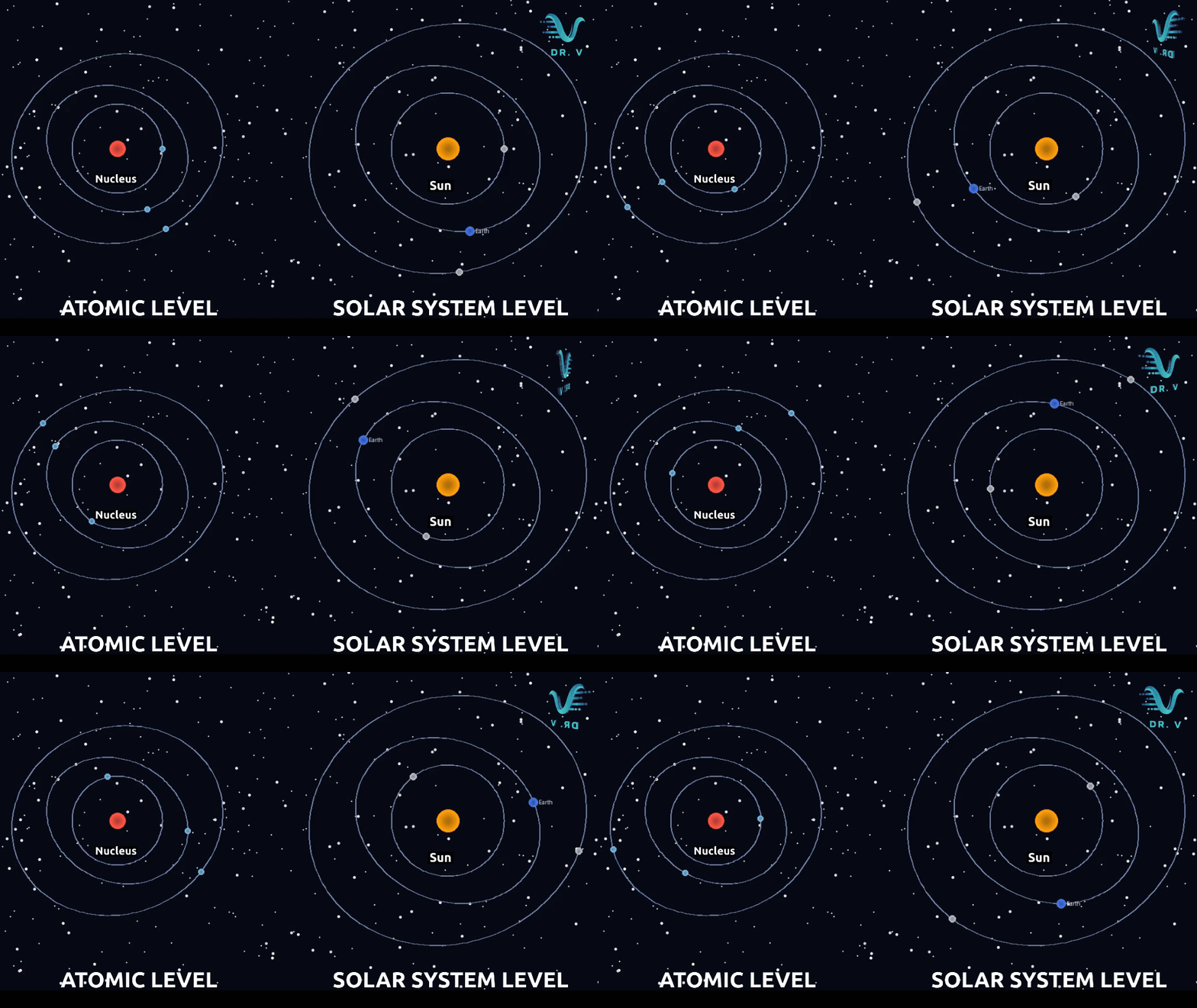
Illustrative comparison: atomic level / solar-system level; nucleus / electron; Sun / Earth; analogous structure; different level of life.
LLTL therefore suggests that life may be organized in repeating or corresponding patterns across different scales. The same broad logic can be applied in reverse: if a solar system may resemble an atom at a larger level, then smaller systems inside biological structures may also represent their own levels of life. This does not imply that all systems are identical. Rather, it means that life may be expressed through structurally related forms at different degrees of scale and complexity. This proposed continuity across scales is one of the theory’s most distinctive and ambitious features.
| What LLTL Tries to Explain |
The theory is intended to address several major questions at once. First, it offers a way to think about the origin of life not as a single random event, but as part of a broader and continuous hierarchy. If life exists within larger living systems and contains smaller organized systems within itself, then the appearance of life on one level may be connected to the existence of life on another level.
Second, LLTL offers a different way to think about biological organization. Instead of treating cells, tissues, organs, organisms, planets, and systems as entirely separate categories, the theory encourages us to consider whether they may belong to one larger order of structured existence, expressed differently from one level to the next. Seen this way, LLTL is an attempt to unify questions of origin, organization, and continuity within one conceptual model.
Third, LLTL reaches into the deepest scientific and philosophical questions. Dr. Alatortsev argues that the theory can be used to examine the origin of life in a scientifically grounded way and can also be applied to the question of the existence and/or absence of a Creator or God. In this sense, LLTL is intended not merely as a speculative idea, but as a framework through which such questions may be approached analytically.
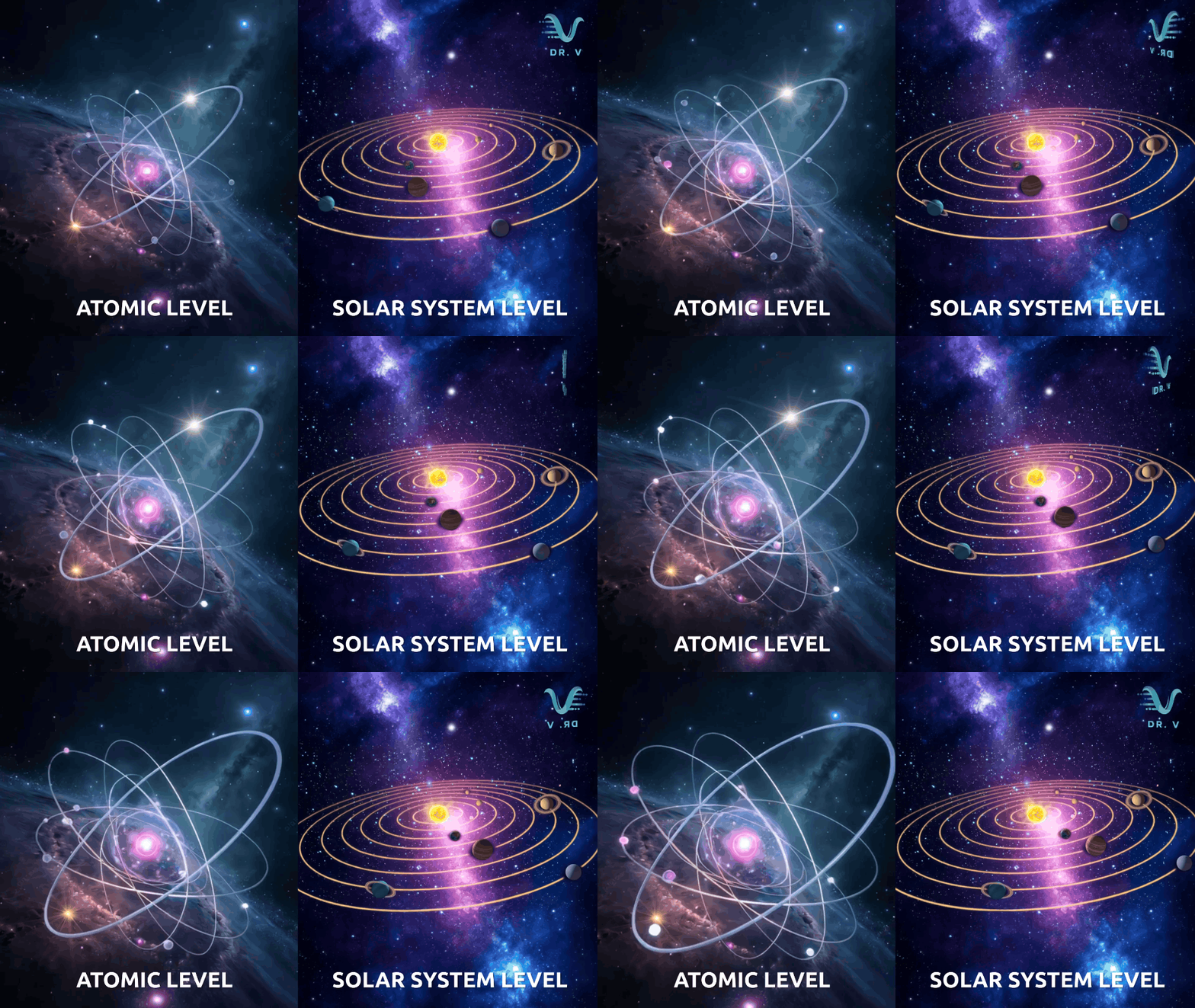
IIllustrative nested levels in LLTL: larger living level / broader organizing system; solar-system or planetary level; organismal / cellular / biological level; molecular / atomic level.
The diagrams above are simplified and illustrative. They are not intended to claim that a solar system and an atom are physically identical. Instead, they communicate the main intuition of LLTL: that structurally related systems may exist at different levels of life, and that recognizing these relationships may help explain both the continuity of life and the place of human existence within a much larger order. For a general visitor, the value of these illustrations is conceptual clarity rather than technical proof.
| Scientific Ambition and Validation |
Dr. Alatortsev regards LLTL as the pinnacle of his scientific work. In his view, the theory can be examined, supported, and ultimately proven through scientific analysis. Because of its scale and implications, however, any serious effort to test or validate LLTL would require substantial interdisciplinary resources, long-term coordination, and institutional capacity. That is why LLTL is presented on this website both as an original theory and as a project whose evaluation would demand resources beyond those of ordinary private initiatives.
For that reason, he takes the position that discussions concerning formal validation of LLTL should be limited to governments. In his assessment, individual investors and ordinary private parties would not have the range of scientific, technological, organizational, and financial resources necessary to carry out the required work. Governments, by contrast, are the only entities likely to possess the breadth of capabilities required for a meaningful evaluation.
| Why LLTL Matters |
LLTL matters because it attempts to connect areas that are usually separated: the origin of life, the structure of living systems, the relationship between scale and organization, and the question of whether the universe itself reflects a deeper order. It provides an accessible but far-reaching framework for thinking about life, not only as biology in the narrow sense, but as a layered and continuous reality. For readers who are interested in foundational questions rather than narrow technical fragments, this is precisely what makes the theory distinctive.
In this sense, LLTL is both explanatory and provocative. It asks the reader to reconsider familiar systems—from atoms to solar systems, from cells to organisms—not as disconnected phenomena, but as possible expressions of life at different levels. Whether approached scientifically, philosophically, or strategically, the theory is intended to open a broader conversation about what life is and where it fits within the larger structure of existence. It is therefore also one of the clearest windows into the larger intellectual style behind Alator Consulting itself.
| Origins of LLTL |
It was later, in 1985, during his years at Kyiv State University in the USSR, while Dr. Alatortsev was immersed in the writings of Vladimir Ilyich Lenin (Ulyanov), that he came to see Lenin as a figure of remarkable intellectual force. To Dr. Alatortsev, Lenin’s significance extended beyond the creation of Soviet power and the founding of the USSR. Lenin had envisioned and built a system in which, for the first time in human history, workers and peasants genuinely stood at the helm of the state.
In that system, as defined by the Constitution, everything—from land and natural resources to factories, banks, and the entire machinery of industrial production—belonged to the people as a whole and functioned for the common good. It provided universal access to housing, education, and healthcare, along with paid vacations and maternity leave for the care of young children. Work was both a guaranteed right and a social duty. At the same time, practices such as usury, prostitution, drug abuse, and social parasitism were prohibited, while crimes like murder, theft, sabotage, and treason were met with severe punishment.
Then, in 1985, Dr. Alatortsev made a discovery that struck him on a deeply personal level. He learned that as early as 1908, at the age of thirty-eight, Lenin had arrived at a conclusion strikingly similar to one Dr. Alatortsev himself had reached in 1980, when he was still a schoolboy: the structural analogy between the atom and the solar system.
In his work Materialism and Empirio-Criticism, in Chapter V, “The Latest Revolution in Natural Science and Philosophical Idealism,” Part II, “Matter Has Disappeared,” Lenin wrote that “the atom can be understood as resembling an infinitely small solar system,” and that “the electron is as inexhaustible as the atom; nature is infinite, and it exists infinitely.”
This realization had a profound effect on Dr. Alatortsev. It strengthened his confidence in what would later become the LLTL theory—a framework he continued to develop over the years, eventually even outlining a path toward its scientific verification. For the reader, this origin narrative provides historical and intellectual context for how the theory emerged and why Dr. Alatortsev treats it as central to his life’s work.
Why Work With Alator Consulting
- Analytical, evidence-based approach
- Multidisciplinary expertise
- Experience across business, technology, and science
- Focus on measurable, long-term results
Engagement Approach
We work closely with clients to understand their objectives, assess challenges, and develop tailored solutions. Each engagement is structured to deliver clarity, efficiency, and sustainable outcomes.
Contact
For inquiries or collaboration opportunities, please contact Alator Consulting to discuss your specific needs.